Thanks, Duncan! Really glad to hear the pre-workouts are working well for you.
1 Like
I am going to try again this time and see 
2 Likes
I lasted about 2 lessons this time. 
Playing the Otherside riff in module three made me very happy! Looking forward to the rest of the course.
3 Likes
I just finished M2L3 this morning. Although the beta was fun, I feel more relaxed now in the finished course. My goal in the beta was to get to the end and provide what feedback I could. Now I’m just making my way through…that is until I reach the full C Major lol…uh. I hate that chord.
1 Like
Any tips on C Major? I remember someone saying use a capo and start on the smaller frets. That sounds reasonable
1 Like
tons of great stuff in the course 
1 Like
As a bass player you will probably adapt to the stretch there faster than you think - it’s actually small potatoes by bass standards stretch-wise but it feels massive because you’re still getting used to chording.
1 Like
thats fair. also, fun fact. cant pick up my 5 string without going for Half God Half Devil first lol
1 Like
Hey there! I think I understand what you’re asking.
In M3L4, by plucking up on E and down on B, you’re getting your pick closer to where you start the picking motion for the next note. If you were to pluck down on E, you’d have to move your pick twice as far to reset for, say, a down on the B string pluck.
It could work going down E/up B as well, but I find the way it’s taught in the lesson to be much more fluid.
Does this answer your question?
2 Likes
Nice, I’m stoked to hear that!
It does. I’ve tried to use the method you’re teaching in the course, but inside plucking still happens. lol
I just finished module 5 - no economy plucking there. That module is a doozy though! That’s pretty much where I’ve given up on my prior attempts to learn guitar over the last 40 years. However, I made it through and I’m ready for more.
3 Likes
Play around with your thumb and wrist position a little. While what I teach in the course is the best starting place, everyone’s a little different.
Try moving your thumb on up or down on the back of the neck to see if you can get better leverage on the front of the neck. Same with dropping your wrist angle a bit, or the opposite. Just trying some subtle tweaks might help.
If you get good results from any of this, then it might be the ticket. Just be sure that nothing feels uncomfortable or too extreme.
1 Like
That’s bound to happen. lol.
And that’s why this course beats all others in my opinion. Other courses made me want to back my car over my guitars. Alex has got your back though. No worries!
3 Likes
im finding when i find the chord shapes (too slow still at the moment) im pressing down soooo hard on the strings and with my thumb at the rear of the neck, squeezing like my life depends on it
ive experimented with how light i actually need to press to get the note, and its a lot lighter than i currently do, but that goes out the window when im transitioning, finding the chords, i just cant help squeezing too tight.
good for callus build tho
3 Likes
You’ll adjust as you go on. breaking a habit is really hard when you JUST noticed it lol. Don’t worry buddy. We’ll get there lol
just done M5L5, capo on fret 3 for D, C and G chords, but i was left not 100% knowing why the capo was used. we were transitioning from D to C to G so i was thinking well if the chords are D, C and G then why not just remove the capo and play proper D, C and G. started thinking laterally and thought well… the G root note isnt actually a G now with that capo, itll be a A# now (i think), so by that reckoning, would the C be a D# and the D be a F (E#)? so in effect did we use the capo because whatever song the riff was from would have used chords A#, D# and F, and those chords would be too tricky to play, so we just used a capo instead to play ‘easier’ finger placements?
and if thats the case, is that how these chords would still be displayed on a music sheet/tab, as ‘capo on fret 3, play G, C and D chords’? they wouldnt be written as A#, D# and F etc?
sorry if im not coming across very well, i realise that all sounds a bit complicated but hopefully you know what i mean
1 Like
Yes. Tabs or Chord sheets will have Capo: 1st Fret, and the chords will be listed as C, D, G, etc. I’ve been doing more country and bluegrass tunes that use capos, and the large majority of all bluegrass is just G-C-D with sometimes an Em. Everything is capo’d to get the right key.
Here’s how it looks on the ultimate-guitar chord sheets: Capo 5th fret, but then the chords are all listed as their open-names.
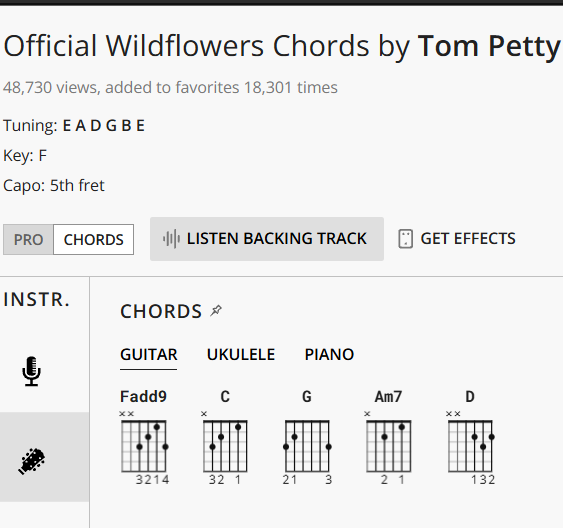
1 Like
thank you. i guess its a silly question, but why not just use the C, G, D, Em etc without a capo, and in their normal positions? is it so the singer has an easier time or something, singing either a bit higher or lower than normal chords?
Yeah, you’re pretty much right on the money. And thanks to @SlackingZac for filling in the gaps.
There are only so many open chords. Open chords utilize open strings and don’t require barring. They’re generally easier to play than, say, barre chords.
So if you see a song with F, Eb, and Bb, like in M5L5, you can use a capo 3rd fret and play a D, C, and G. This allows you to play easier open chords and avoid tricky barre chords.
So yes, the chords are technically F, Eb, and Bb, but a traditional guitar chord chart would just say D, C, G and specify capo 3rd fret.
If you were playing with other musicians, you would have to use the real names of the chords, F, Eb, Bb for everyone to be on the same page.
Ding ding! Singers usually have the last word about which key the song is in, so this is a big part of it.
But also, if we just used D, C, and G all the time, all songs would start to sound the same after a while. Capos allow us to explore different sounding keys that don’t work well for open position guitar (like Bb, B, F#, etc).
Sorry for the long winded answer. Hopefully it all makes sense!
3 Likes